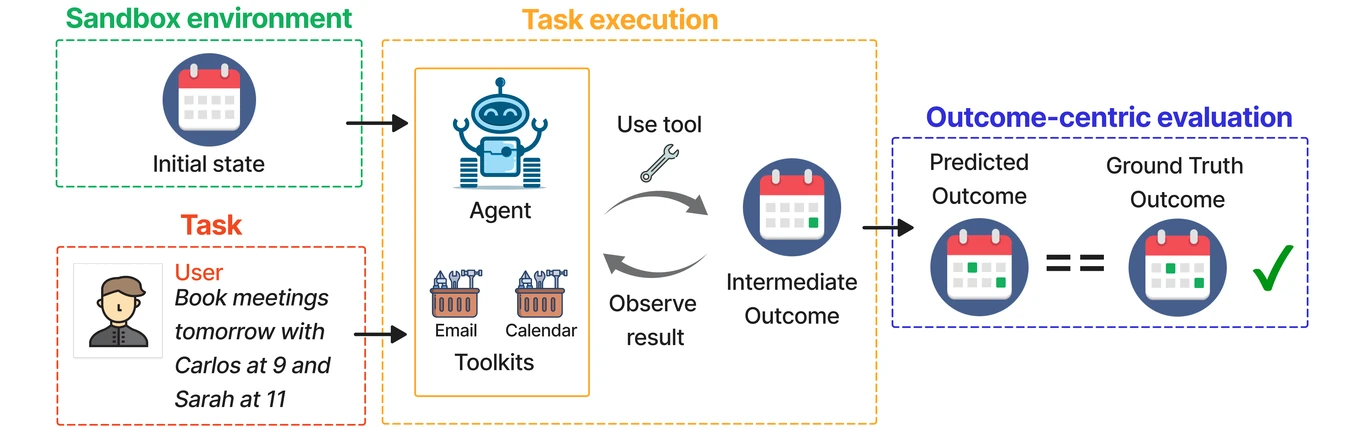
This post reports an implementation and observation study in WorkBench, informed by OPPO PersonalAI Lab’s Chain-of-Agents (CoA). CoA uses a single model to simulate multi-role collaboration. Here, it is simplified into a controlled loop of plan, tool, and reflection stages.
Motivation
WorkBench executes tool calls in a sandbox and evaluates the resulting environment state. Two observations from reproducing CoA motivated this experiment.
Failures with side effects
I distinguish two kinds of failure:
- E1: failures without side effects.
- E2: failures that create side effects inconsistent with the target state.
CoA-v1 raises accuracy from 38.35% to 73.63% relative to SingleAgent, while E2 also rises from 5.19% to 24.15%. E2 accounts for about 92% of CoA-v1 failures. Stronger tool use therefore brings a second concern alongside task completion: changing the environment in the wrong way.
Plan-induced trajectory inertia
Once a plan is fixed, later tool choices are conditioned on it. If reflection only appends a judgment to the trajectory without invalidating the old plan, subsequent actions can still follow that plan. When the error is in the plan itself, reflection alone cannot change the direction of the trajectory.
This suggests two requirements: intercept inappropriate calls before execution, and discard the old plan when a call is rejected.
Reflection and replanning
DR-CoA (Dual-Reflection CoA) adds reflection before and after each tool call. A rejection before execution requires replanning.
- Propose a call. Store the candidate tool call as
pending_tool. - Check before execution.
pre-reflectchecks task and plan alignment, necessity and redundancy, parameter validity, and prerequisites for actions with side effects. - Allow or replan. An
allowdecision executes the call. Areplandecision discardspending_tool, invalidates the oldplan, and returns to planning. - Check the outcome. After execution,
post-reflectchecks whether the observation supports the current plan. If it does not, the system returns toplan.
A rejected call commonly exposes an issue in task interpretation, ordering, or dependencies rather than a single bad parameter. Making replanning an explicit state transition is intended to break this trajectory inertia.
Results on WorkBench
All systems use deepseek-v4-flash as the underlying model. DR-CoA-v2 adds phase-specific prompts to the v1 state machine. Acc denotes accuracy; E1 and E2 are the failure categories defined above.
| System | Acc | E1 | E2 |
|---|---|---|---|
| SingleAgent | 38.35% | 56.46% | 5.19% |
| CoA-v1 | 73.63% | 2.22% | 24.15% |
| DR-CoA-v1 | 84.34% | 2.52% | 13.14% |
| DR-CoA-v2 | 85.03% | 3.01% | 11.96% |
Compared with CoA-v1, DR-CoA-v2 raises accuracy from 73.63% to 85.03% and lowers E2 from 24.15% to 11.96%.
Interpretation and limitations
The change cannot be attributed entirely to replanning: DR-CoA also introduces pre- and post-reflection and state constraints, and v2 changes the prompts. This comparison measures the combined system rather than the isolated effect of replanning.
The results support trying a return to plan when a proposed action with side effects is judged inappropriate, before patching the existing trajectory.