This note documents an attempt to build an automated development workflow with dsh-agent-teams. The workflow separates requirements, implementation, verification, review, and merging into distinct roles, with GitHub PRs as stage boundaries. It completed roughly 40 PRs and over 100 commits; operation exposed state drift and reliance on manual scheduling. To address these issues, this note introduces the design goals of a new plugin, dsh-auto-workflow.
Implementation
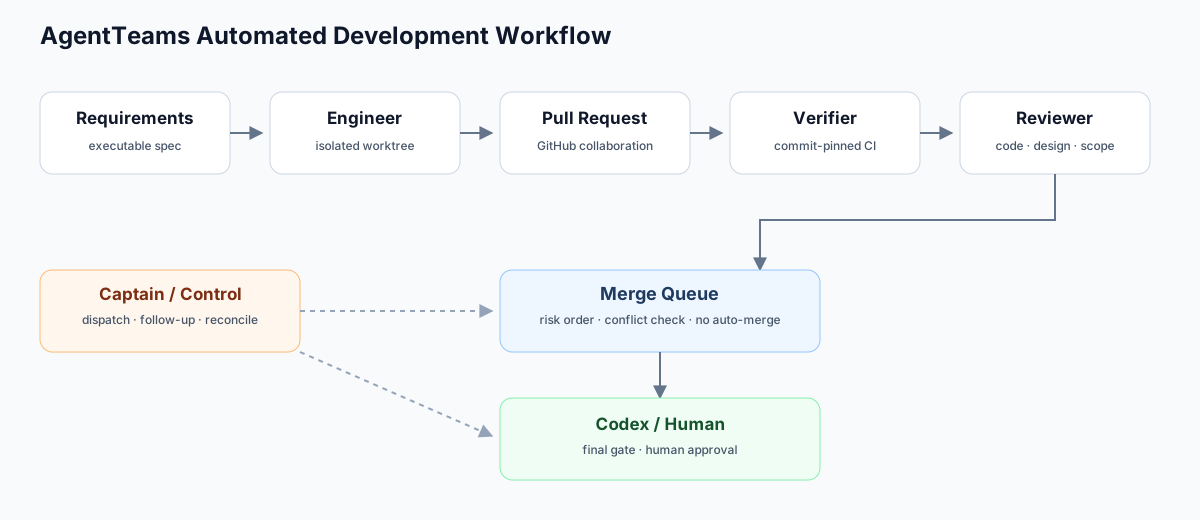
dsh-agent-teams allows long-running agents to be defined with roles, tools, tasks, and scheduling logic. The workflow uses five roles:
| Role | Responsibility |
|---|---|
| Requirements | Turn a request into an executable spec and acceptance criteria |
| Engineer | Implement in an isolated worktree and open a PR |
| Verifier | Run tests and CI against the acceptance criteria, pinned to a specific commit |
| Reviewer | Independently review the code, design, and scope |
| Captain | Coordinate tasks, follow up on PRs, and handle exceptions |
Each task is described as a contract with four fields: the goal states the problem to solve; acceptance defines executable completion criteria; scope limits the files or directories that may be changed; verification lists the commands and CI checks that must run.
A task starts when the Requirements agent submits the spec. The Engineer creates an isolated worktree from the latest main, implements the change, and opens a PR. The Verifier runs tests and CI against the PR’s acceptance criteria and binds the result to a specific commit. The Reviewer independently reviews the code, design, and scope. Once review passes, the PR enters the merge queue and is merged by a human or Codex.
The workflow enforces the following constraints:
- Each task starts from an isolated worktree created from the latest
main; no edits are mixed into the main checkout. - Implementation, verification, and review must be performed by different agents.
- Verification must be pinned to a specific commit and must use real CI results.
- Failed review sends the task back to implementation; verification and review then run again.
- Merge authority stays with a human or Codex; the Captain and members do not merge automatically.
The Captain maintains task state across implementation, verification, review, and merge, and handles conflicts, CI failures, and quota exhaustion.
Results and Issues
The workflow completed roughly 40 PRs and over 100 commits. The results show that multi-role collaboration and PR boundaries can support real development, but the following issues remain.
First, it is not fully automated. Requirement trade-offs, merge order, conflict resolution, and confidence in verification still require human judgment.
Second, state drifts and operation is unstable. Agents fail, context limits are exceeded, and providers rate-limit. The Captain’s context accumulates and drifts, so its state gradually diverges from the repository. Members are removed and re-added because of quota or tooling issues, which forces old tasks to be re-queued. Humans still have to interrupt, correct, and re-establish boundaries.
Third, scheduling depends on humans. Automatic task dispatch is unreliable. After a failure, pause, or member change, tasks must be dispatched again. The Captain effectively becomes a dispatcher.
The common cause is that workflow state depends on the Captain’s session context. This motivated dsh-auto-workflow, whose goal is to move workflow state, tasks, and scheduling rules out of the Captain session and persist them in the plugin. The plugin is still under development; this note records the results and issues of the previous workflow, not a release announcement for dsh-auto-workflow.